Earth Notes: 16WW Heat-pump Load Profile
Updated 2026-06-21.Heat pumps in the home are expected to be a major new demand on the grid: the infamous "Beast from the East" induced maybe 100GW gas heating demand, and even with a reasonable CoP at lowish temperatures, that would about double current typical winter electricity grid demand when moved across.
Establishing and using the flexibility of this demand for space heating and DHW (Domestic Hot Water) is important for a stable grid and acceptable prices.
The UK government SSES (Smart Secure Electricity System) [govUK2025ESA], and studies from pure academic to, for example, the Energy Systems Catapult Heat pump consumption shows elevated demand throughout the day with two distinct peak periods: [–] and –
[rowe2025grid] continue to explore this area. There are no known "right answers" at the scale and speed needed!
I originally started with a quick check if our electricity load profile had significantly changed since , given the new heat pump, using data for the first 19 full days in December, with extended scripts. (See also an extended look at our changing profiles.) 
All of December's data for electricity for heat reveals a similar picture. 
eheat heat pump consumption plus diversion/boost (boost is pasteurisation) for the whole of was made with sh script/storesim/load_profile.sh -eheat 202412.
I will delay the DHW evening period start 10 minutes to , pushing it a little further down the slope from peak grid demand time. Still not at a half hour (HH) boundary. No one in the house will likely ever notice.
As of no one seems to notice nor mind the DHW and space heat setbacks, and they are shifting some load away from grid evening peak. From watching various temperature graphs, the current -3°C LWT/flow setback during that peak seems reasonable, though it could go back a bit further with possibly a rise just ahead, given that the old gas CH was simply off for this time.
As of after more observation of room temperatures, I have eased the peak-time LWT setback down to -4°C to lower electricity demand a little, by aiming to allow temperatures of unoccupied rooms to drop slowly.
Hourly hph4 heat pump consumption alone for was made with sh script/storesim/load_profile.sh -hph4 202502. 
hph4) so excluding PV diversion and from-grid pasteurisation boost . Data and other views are available.
: full year grid profile
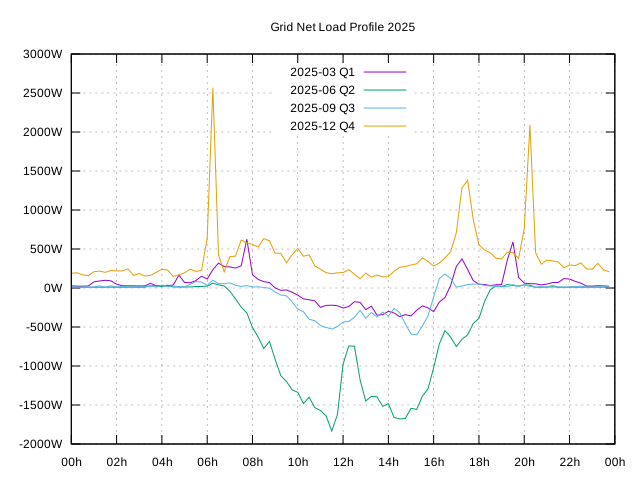
sh script/load_profiles_quarterly.sh 2025.: Pint of Science
Gave a Pint of Science talk [PDF] on why shaping the electric heating demand profile curve, household by household, is important.
: Conference Poster
I presented a poster [PDF] at the Doctoral College PGR conference on the demand profile curve ideas.
: SSES Peak Hours
The SSES [govUK2024electricity] government response emerged today, and I was not even half-way through before this pronouncement set me thinking: Manufacturers must ensure that appliances incorporate pre-set default usage hours that are outside of peak hours, defined as 8am to 11am and 4pm to 10pm on weekdays.
What might I meaningfully do with our heat pump settings to nominally comply?
Our morning DHW demand when covered by the heat pump is already in SSES off-peak hours. The evening demand chunk is harder to do much about, especially given the limited number of DHW programme slots in the Daikin.
An analysis of boiler calls for heat from the Radbots via the OpenTRV unit each hour UTC in , our coldest month with the heat pump so far:
% gzip -d < data/OpenTRV/pubarchive/remote/202501.json.gz | \
    sh script/analytic/boilerCallFraction.sh
n 8202
boilerOff 4108
boilerOn 4094
boilerOnFraction 0.499147
boilerOnFractionHH 00 0.16954
boilerOnFractionHH 01 0.136232
boilerOnFractionHH 02 0.105882
boilerOnFractionHH 03 0.122449
boilerOnFractionHH 04 0.101156
boilerOnFractionHH 05 0.146552
boilerOnFractionHH 06 0.424855
boilerOnFractionHH 07 0.641618
boilerOnFractionHH 08 0.659701
boilerOnFractionHH 09 0.786127
boilerOnFractionHH 10 0.752161
boilerOnFractionHH 11 0.715152
boilerOnFractionHH 12 0.708709
boilerOnFractionHH 13 0.680233
boilerOnFractionHH 14 0.691429
boilerOnFractionHH 15 0.700599
boilerOnFractionHH 16 0.724551
boilerOnFractionHH 17 0.745562
boilerOnFractionHH 18 0.866667
boilerOnFractionHH 19 0.715976
boilerOnFractionHH 20 0.37092
boilerOnFractionHH 21 0.453521
boilerOnFractionHH 22 0.389381
boilerOnFractionHH 23 0.197015
There are 8202 boiler call samples, about half calling for heat and half not. About 10% of the time a call for heat persists overnight, sometimes because a room did not get to temperature before the night WC setback. In any case these could be particularly cold days that need more heating time. There is only a little apparent extra call for heat beyond that at 05h, before the normal (not set-back) WC curve is in place at . There is plenty of call for heat at 21h and 22h, which suggests bringing forward the 'normal' start a little, and pushing the night setback back almost to .
The hours of the SSES morning peak to have enough heat demand that a small (-1°C to -2°C) WC setback there may be useful, as well as in the existing slot.
A -1°C WC setback may result in ~10% heat demand reduction for rooms whose temperatures are being limited by flow temperature rather than TRV.
The existing scheme is:
Something more like this, in terms of setbacks on the WC curve, might work:
- All of the SSES peak period hours have a WC setback.
- The main evening grid demand peak has the maximum (night) WC setback.
- Heating times have been slightly extended to allow for lower-temperature intervals.
- No setback level changes happen on full/half hour boundaries, helping to avoid being part of any 'herding'.
The same schedule would be applied to all days of the week to reduce complexity, and because I understand it to be unhealthy to have too big a difference in routine (etc) between different days.
[brudermueller2025efficiency] suggests that a 1°C setback of the WC curve results in a reduction in energy demand of 2.61%. This implies that a setback of 5°C saves ~13% and 2°C saves ~5%. Some of that 'saving' may be consumed in recharging the thermal capacitance of the house in non-setback periods.
A version with a 1h boost before the main evening setback to try to ensure everything is up to temperature or a little over (though with minimal SSES 'peaks' setbacks since I am sceptical of their value) to better coast through the deep setback:
GB carbon intensities by hour available from/with:
curl -L -s https://api.neso.energy/dataset/88313ae5-94e4-4ddc-a790-593554d8c6b9/resource/f93d1835-75bc-43e5-84ad-12472b180a98/download/df_fuel_ckan.csv
The following warmer January, for comparison:
% gzip -d < data/OpenTRV/pubarchive/remote/202601.json.gz | \
    sh script/analytic/boilerCallFraction.sh
n 8419
boilerOff 5191
boilerOn 3228
boilerOnFraction 0.383418
boilerOnFractionHH 00 0.149296
boilerOnFractionHH 01 0.137536
boilerOnFractionHH 02 0.0432277
boilerOnFractionHH 03 0.0319767
boilerOnFractionHH 04 0.0368272
boilerOnFractionHH 05 0.0833333
boilerOnFractionHH 06 0.144928
boilerOnFractionHH 07 0.708683
boilerOnFractionHH 08 0.79096
boilerOnFractionHH 09 0.646067
boilerOnFractionHH 10 0.591304
boilerOnFractionHH 11 0.588732
boilerOnFractionHH 12 0.344729
boilerOnFractionHH 13 0.427762
boilerOnFractionHH 14 0.477273
boilerOnFractionHH 15 0.448276
boilerOnFractionHH 16 0.441667
boilerOnFractionHH 17 0.511561
boilerOnFractionHH 18 0.630372
boilerOnFractionHH 19 0.464387
boilerOnFractionHH 20 0.467422
boilerOnFractionHH 21 0.242938
boilerOnFractionHH 22 0.471098
boilerOnFractionHH 23 0.298851
: DHW Later Evening Run
There is an argument to put back by 1h the post-peak DHW 'eco' slot, primarily there to cover the occasional evening shower or bath. Yesterday and today () GB demand did not peak until ~Z, ie local. Though currently all heat-pump DHW demand is covered by the Enphase batteries.
The current scheme is:
The new scheme is:
I might drop in the change ~ to see if anyone notices. Our DHW usage pattern does not change hugely with season. We might come unstuck when Ellie is home in winter and she and Morgan both want an evening shower/bath, since 1h20 is not really enough time to guarantee a full warm-up, especially while I am limiting heat pump power in.
(I see that DHW top up in the evening has not happened on many/most recent days, I assume because the tank losses are smaller with the ~25°C kitchen temperature.)
: Complexity Limit
The Daikin only allows six heating-schedule weather-compensation curve-adjustment events per day, so the pre-evening-peak boost is going to have to go. I am putting this schedule in to the system this evening, ready for December!
: 30% Load Shift with +/- 1K Setpoint Tweaks
A trial by Ovo/Nesta [wollard2025flexibility] using a 2h/4h +1K setpoint preheat and a 4pm–7pm -1K setback claims to have shifted approximately 30% (~0.75kWh/d) of heating demand away from the peak period.
: Warmer Water
On enquiring yesterday about water temperatures I was told it was not warm enough some times. Though first thing in the morning seems to be OK, washing up after the evening meal may be more of an issue. I might be able to tackle that by reducing the hysteresis or scrapping the evening eco slot from and moving an elevated temperature slot before . As a small experiment I have this morning raised the initial main block from eco (45°C) to comfort (48°C). There will be an energy cost, from lower CoP and increased tank losses.
This could be automated to some extent by using DHW weather compensation, to keep the DHW tank cooler in summer and reduce standing losses, when diverted PV can be expected to provide hotter water. Greater losses from the tank to the kitchen in winter are less of a nuisance and would indeed partly substitute for space heating. A two-point WC curve with an external temperature range between (say) 10°C and 15°C (the latter is the space-heat activation threshold), corresponding to DHW target of 48°C to 45°C (or lower, down to 42°C) might be reasonable, possibly with ~24h external temperature smoothing.
Initial data suggests that this may be costing an extra ~0.15kWh electricity (from ~0.45kWh to ~0.6kWh) in the morning 6am DHW heating slot.
: Octopus Cosy Thoughts
Octopus offers a Cosy
tariff for heat pumps (for homes without an EV):
- Three cosy periods of super cheap rates between 04:00 – 07:00, 13:00 – 16:00 and 22:00 – 00:00 every day, 51% cheaper than the Day rate in your region.
- A peak rate between 16:00 – 19:00, 50% above the Day rate in your region.
That corresponds to 7 (seven) pricing periods per day. My Daikin only allows 4 DHW and 6 SH changes per day. And we all tend to go to bed at 10pm or soon after, so that last – slot would be difficult to use with the heat pump, though could be used for charging the (Enphase) battery (or Thermino), or running the dishwasher.
The electricity that we use at peak rate, mainly cooking, would need considering.
Thought experiment: if on this tariff, how might things be organised to minimise cost and carbon?
Here is a plan:
- Try to minimise consumption at peak, if possible, maybe shift some cooking earlier.
- Run the dishwasher in one of the cheap slots if not covered by solar during the day, preferably – for grid friendliness.
- Ensure that the battery has enough charge to cover peak period demand, force charging from grid in the – slot if not already full enough from PV, so especially in winter. Possibly extend this force charging to each of the cheap slots to (just) cover anticipated demand in the following non-cheap period.
- Adjust the morning 'green' period for pasteurisation to use the – slot.
- Have DHW set for comfort in the – and – slots (expecting the second one to force a boost), eco between those two, and reheat the rest of the time, ie from and overnight.
- Have space heat run WC+1K in the – and – slots, WC-1K between them (to cover the SSES morning peak), WC-5K in the – peak slot, then WC-1K from then until to cover the SSES evening peak, and then maybe WC-5K overnight until .
All of this upheaval might save ~£50 per month for 3 or 4 winter months, thus maybe 30% of our predicted ~£600 annual energy bill. No behaviour change is needed if the battery can be force-charged when needed in the – slot to be able to carry all the load in the following peak. That saves money but slightly raises carbon emissions from round-trip losses. (Note that the battery cannot meet all peak power demands from cooking, nor from the heat pump when running without a power limit eg when defrosting.)
Looking at a sample of hourly demand as seen by the Eddi for the ~20 first days of this very mild December for the evening peak hours (hour UTC, samples/days, hph4 W, grid W) suggests ~2kWh to cover all house demand during this time as-is:
16:00:00,20,69,311
17:00:00,20,198,1135
18:00:00,19,138,484
That would take under 2h of the cheap slot to load into the battery from grid.
Looking at consumption as seen by the Enphase (15-min UTC block, samples/days, gross consumption W, grid W) which has been the coldest month so far with the heat-pump, suggests that a mean of ~2.5kWh would be needed in the battery, still feasible:
16:00:00,31,439,364
16:15:00,31,521,460
16:30:00,31,690,647
16:45:00,31,844,808
17:00:00,31,1032,1005
17:15:00,31,1417,1362
17:30:00,31,1457,1439
17:45:00,31,935,937
18:00:00,31,751,755
18:15:00,31,687,676
18:30:00,31,650,646
18:45:00,31,702,697
: Quiet Mode as Power Limit?
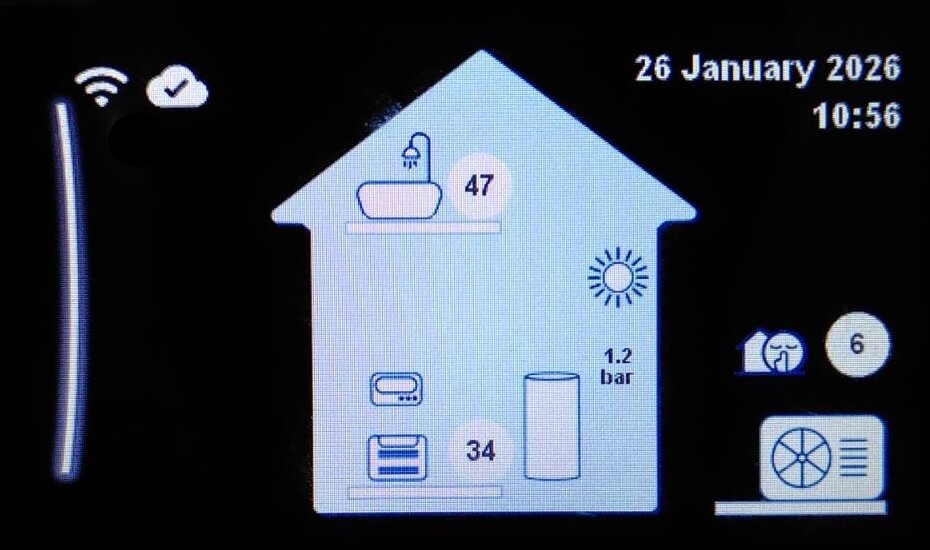
I am still looking for a year-round safe setting to limit the heat-pump power so that outside winter any heat-pump demand can be covered by the Enphase. I do not want settings that I need to remember to make or remove around winter to avoid risking the heat pump failing one way or another. So that disqualifies a 5A continuous power limit for example, though other than 'emergency' defrosting, is very close to what I want, short of being able to dynamically respond to PV generation and battery levels.
The heat pump has three levels of 'quiet' mode beyond not quiet — 'quiet', 'more quiet', 'most quiet' — which seem to cap maximum output to 75%, 50% and 25% of maximum. 'Most quiet' seems to be recommended against in cold weather, and might indeed reduce output below our design-day ~2kW demand.
Today (I am at home, there is low (de)frost risk), I have experimentally put the pump in manual 'quiet' mode to see if it blunts the DHW demand peaks, maybe getting it to within the Enphase power ~5A power limit.
There is a possibility of this reducing CoP, though reports on line suggest that this is in fact not an issue.
It may be useful to set a 'quiet' schedule to cover DHW generation and the SSES and grid peaks. That might be 'quiet' from ~–, 'more quiet' from ~–, and back to 'quiet' from ~–. Or possibly 'more quiet' for all of these times to get closer to 5A max. Or '(more) quiet' from –, to also reduce any night-time noise.
Noise from the external unit has simply not been an issue at all so far, to be clear.
The evening DHW run starting at (outside is ~8°C) seems to be showing a peak demand of ~1800W, higher than the Enphase could cover at best. So plain 'quiet' mode would not be enough to avoid drawing from grid when the heat pump runs when there has been recent PV generation, at least at in this chilly weather. It might be enough in warmer weather when the DHW CoP is higher. This evening's DHW run does seem to have been wider and lower, and possibly using a little more energy in total, than yesterday's.
After the DHW run finished at ~, as further experiment I put the heat pump into (manual) 'more quiet' mode to try to moderate the next morning run's peak demand. The setting probably cannot be left there if the house and DHW are to come up to temperature in reasonable time on very cold mornings, though it would be unlikely to cause outright failure.
The morning run took ~25 minutes (outside is ~7°C) with imports peaking at ~1800W, so maybe a fraction lower than last night, and consumption maybe slightly higher, but nothing dramatic.
I will try a 'most quiet' setting before my bath, and DHW replenishment for it.
My initial inclination was to go for a 'quiet' schedule from ~– covering DHW runs and SSES peak times and night-time, but fully unleashed during daytime when needed for very cold days.
~ 'most quiet' mode engaged, while space heating running. What looks like the following DHW cycle at ~ for ~35m seems to have drawn ~1000W–1300W (full imports ~1250–1500W), so could be within the Enphase power limit.
Today I set a 'quiet' – schedule. I hope that as weather and CoP improve then the peak demands will simultaneously shrink to fit the battery power limit... Meanwhile, DHW demand should be a bit less spiky.
Under this new regime, the evening DHW run had grid imports peak at ~1900W, which implies peak heat pump demand at ~1800W or less, much as expected. Two nights ago the imp/hph4 was ~2600W/2500W. That morning the imp/hph4 was ~3300W/3200W.
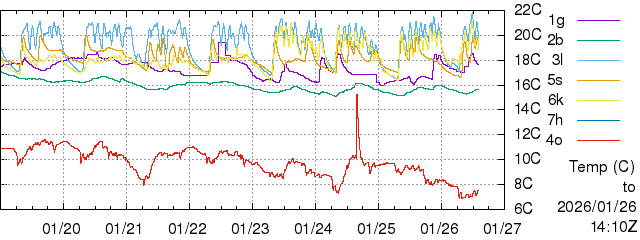
: CoP drop?
I am suspicious that energy demand for the 'quiet' DHW runs has gone up a bit, maybe as much as 20%, presumably from reduced CoP. Outside temperatures have been dropping though, which may explain the changes (see red 4o in the graph, right, and ignore the spike). Further observations are needed...
The hour typically including the morning DHW run (with some space heat):
% sh script/myenergi/eddiDaySummary.sh -byHour -m | egrep T06:
2026-01-01T06:00Z,1,0,0,1.366,0,0,0,1.261
2026-01-02T06:00Z,1,0,0,1.054,0,0,0,0.948
2026-01-03T06:00Z,1,0,0,1.038,0,0,0,0.939
2026-01-04T06:00Z,1,0,0,1.154,0,0,0,1.011
2026-01-05T06:00Z,1,0,0,1.229,0,0,0,1.025
2026-01-06T06:00Z,1,0,0,1.311,0,0,0,1.148
2026-01-07T06:00Z,1,0,0,1.054,0,0,0,0.961
2026-01-08T06:00Z,1,0,0,1.119,0,0,0,0.961
2026-01-09T06:00Z,1,0,0,1.017,0,0,0,0.899
2026-01-10T06:00Z,1,0,0,0.132,0,0,0,0.021
2026-01-11T06:00Z,1,0,0,1.106,0,0,0,1.003
2026-01-12T06:00Z,1,0,0,1.139,0,0,0,0.972
2026-01-13T06:00Z,1,0,0,0.86,0,0,0,0.731
2026-01-14T06:00Z,1,0,0,1.291,0,0,0,1.16
2026-01-15T06:00Z,1,0,0,0.914,0,0,0,0.785
2026-01-16T06:00Z,1,0,0,1.101,0,0,0,0.993
2026-01-17T06:00Z,1,0,0,0.835,0,0,0,0.723
2026-01-18T06:00Z,1,0,0,1.372,0,0,0,0.9
2026-01-19T06:00Z,1,0,0,0.903,0,0,0,0.775
2026-01-20T06:00Z,1,0,0,0.973,0,0,0,0.771
2026-01-21T06:00Z,1,0,0,0.988,0,0,0,0.835
2026-01-22T06:00Z,1,0,0,0.889,0,0,0,0.775
2026-01-23T06:00Z,1,0,0,0.948,0,0,0,0.847
2026-01-24T06:00Z,1,0,0,1.136,0,0,0,1.02
2026-01-25T06:00Z,1,0,0,1.122,0,0,0,1.01
2026-01-26T06:00Z,1,0,0,1.16,0,0,0,1.005
2026-01-27T06:00Z,1,0,0,1.248,0,0,0,1.115
2026-01-28T06:00Z,1,0,0,1.01,0,0,0,0.853
2026-01-29T06:00Z,1,0,0,1.419,0,0,0,1.245
2026-01-30T06:00Z,1,0,0,0.718,0,0,0,0.615
2026-01-31T06:00Z,1,0,0,0.702,0,0,0,0.601
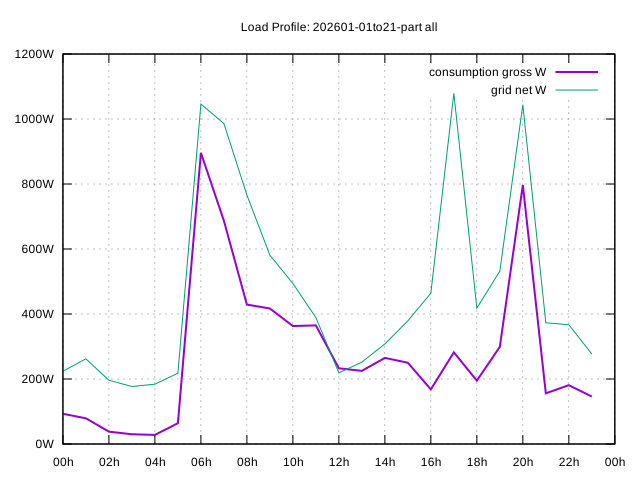
hph4 (heat pump) and net grid flows for up to and including before quiet mode was engaged, generated with sh script/storesim/load_profile.sh -hph4 202601-01to21-part. Times UTC. Data and other views are available.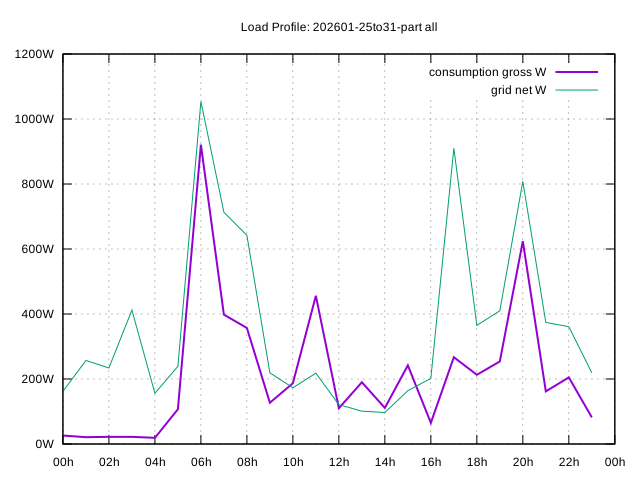
hph4 (heat pump) and net grid flows for from and including after quiet mode was engaged, generated with sh script/storesim/load_profile.sh -hph4 202601-25to31-part. Times UTC. Data and other views are available.The grid demand DHW peaks are lower and a bit wider after applying quiet mode, and hph4 DHW means for the DHW run hours are less or the same, which is good. 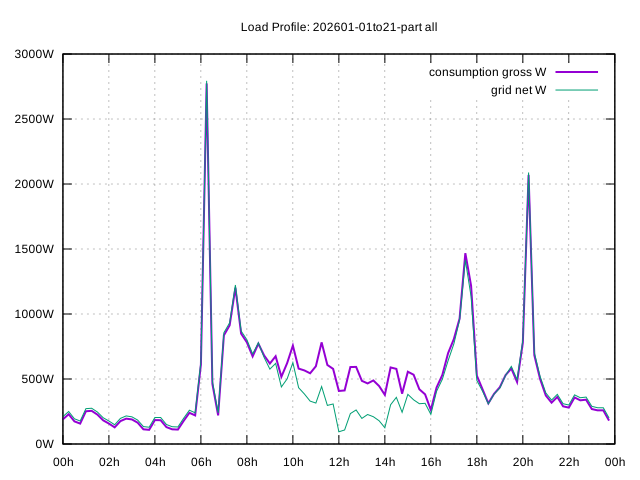
sh script/storesim/load_profile.sh 202601-01to21-part. Times UTC. Data and other views are available.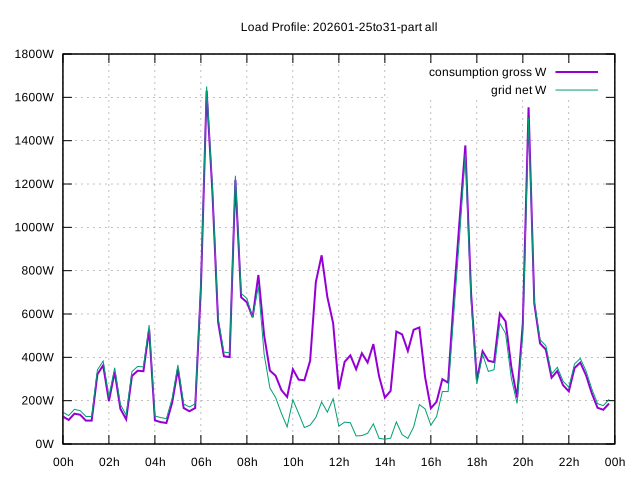
sh script/storesim/load_profile.sh 202601-25to31-part. Times UTC. Data and other views are available.
The demand spikes are now lower, and efficiency is better or no worse.
: 05:10 DHW?
There is an argument for bringing the morning run forward into the typical-minimum GB-grid demand half-hour slot, especially if the heat pump can be kept quiet (and avoids noisy defrost)!
: more quiet
Just before I strengthened the scheduled 'quiet' times for the heat pump to 'more quiet'. Even though the weather is getting a bit warmer (space heating was turned off yesterday) peak DHW power demand (in the morning, to get to 48°C) is still ~1800W, thus exceeding the ~1250W limit of the Enphase battery and forcing grid import.
For this evening's DHW run the heat pump seemed to be drawing up to ~1500W, still too high for the Enphase, forcing imports of ~400W. ~9°C outside. The run (starting ~) took ~35m and from – (Eddi figures) ~0.11kWh was imported, with ~0.68kWh consumed by the heat pump.
Yesterday's evening DHW run (20h) Eddi numbers were ~0.28kWh imp and ~0.97kWh hph4.
This may have to do, even though no import leakage would clearly be better. I could try 'most quiet' for just the DHW hours, but demand may drop within the Enphase power limits with warmer conditions. Note that the kettle being used just afterwards forced import of ~0.03kWh.
: 33% leak
This morning's DHW run during 06h showed ~600W imports for ~35m; over the hour imp of ~0.3kW out of ~0.9kWh hph4.
: most quiet?
Even though the Enphase is sometimes not completely emptied each day, the DHW runs are still not being completely covered by the Enphase because of the power limitations, and the mornings in particular are going to remain in single-digits °C until the end of March it seems.
So I think that I will have to try plan C, ie 'most quiet' at the DHW expected generation times, especially morning. I will find out how many 'quiet' changes per day the Daikin will support, and thus how complex a set-up is optimal.
I am setting 'most quiet' from (local time, ie moving with daylight saving) – and –.
The quiet schedule seems to allow 6 changes per day. So I will also keep 'more quiet' on overnight between those two, ie – to be nice to neighbours and spread what little heat-pump demand there is then.
I still have two schedule slots free. I shall extend the 'more quiet' to cover the times up to and from as before.
The net result is to have 'more quiet' from – as before, with the two new 'most quiet' times around DHW generation at – and –.
: still leaky
Assuming that the 'most quiet' has engaged, it does not seem to have reined in peak DHW power demand enough or at all. This is a disappointment.
: still nearly half leaks at peak
It seems that even in 'most quiet' getting on for half/~800W of peak DHW demand leaks through as imports from the grid in the morning run to 48°C, though this time of day has still been cold (~8°C).
The evening DHW run to 45°C seems better contained by the Enphase.
It may be time to resurrect the WC curve idea to shut down the import leakage as the weather gets warmer, dropping the morning DHW target to 45°C when most DHW should come from the Thermino anyway. Maybe a threshold of 15°C outside averaged over several days would do it.
: easing warmer
With external temperatures ~16°C this morning, the DHW run forced an import from grid of only ~300W (~0.2kWh), so the issue is easing.
The newly re-jigged off-grid controls, to take load off-grid during grid imports, avoids another ~12W of imports!
Sunrise is only about 30 minutes after the morning DHW run now, so as dawn comes forward live generation will also eat into DHW imports.
: cooler April showers
With the somewhat warmer outside temperatures, first PV generation now overlapping with the morning DHW cycle, and some DHW cycles skipped entirely due to PV diversion, this 'leakage' is becoming less significant.
Noting that the 48°C DHW 'comfort' temperature may even be a tad too high, and how much harder the heat pump has to work for that versus 45°C, I have turned down the global DHW comfort setting to 47°C. That should help throughout the year with consumption and morning grid demand.
DHW temperature and power settings are thus currently:
References
- [brudermueller2025efficiency] Estimation of energy efficiency of heat pumps in residential buildings using real operation data
- [govUK2024electricity] Open consultation: Delivering a smart and secure electricity system: implementation
- [govUK2025ESA] Open consultation: Smart Secure Electricity Systems (SSES) Programme: first phase energy smart appliances regulations
- [rowe2025grid] Grid impacts of heat pumps, EVs and solar revealed
- [wollard2025flexibility] The future of heat: How to drive decarbonisation with innovative tariffs and automated flexibility
(Count: 5)